
April 30, 1975: The Fall of Saigon
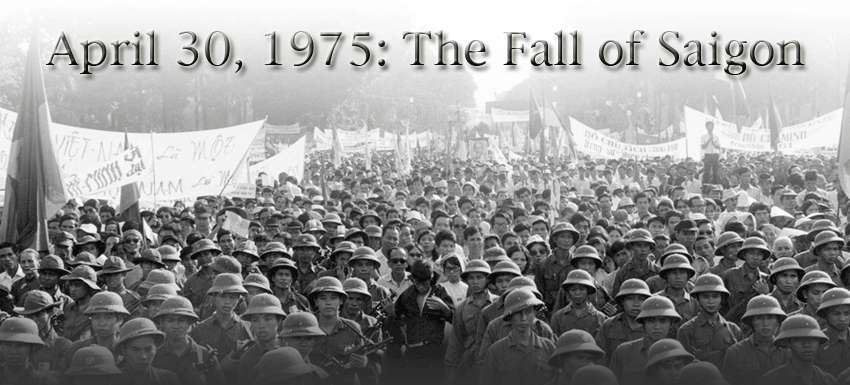
For many in America, the Vietnam War ended in 1973 with the signing of the Paris Peace Accords and the subsequent withdrawal of the U.S. military from Vietnam a few months later. The United States' involvement in South Vietnam, however, lasted for two more years. Many believed that with continued American financial support and guidance, South Vietnam could maintain its status as an independent state. To help pursue this goal, a token force of 159 U.S. Marines were left behind to secure the U.S. embassy and Consul General's offices in Da Nang, Nha Trang, Bien Hoa, and Can Tho; another 50 military officers remained to create the new Defense Attache's Office (DAO). The DAO monitored the situation in South Vietnam, managed U.S. aid and the distribution of munitions and weapons to the Army of the Republic of Vietnam (ARVN), and provided support to the U.S. contractors remaining in Vietnam.
The new status quo held in Vietnam until the end of 1974 when several factors led to the demise of South Vietnam. The Arab-Israeli War of 1973 triggered an economic crisis with rising inflation and soaring petroleum prices causing problems all over the world, and, more significantly, angered American consumers. The political environment in America had changed drastically: President Richard Nixon resigned from office in August of 1974 and the American people were becoming increasingly vocal against continuing aid for a war that had supposedly ended in 1973. Eventually, Congress bowed to the pressure and significantly cut Vietnam's military and financial aid. Faced with a money shortage and high inflation, South Vietnam was suddenly unable to purchase the weapons necessary to engage the North Vietnamese army. During this time of crisis, the North Vietnamese secretly planned a major offensive meant to push deeply into South Vietnam's territory in early 1975.
Vietnam Center & Sam Johnson Vietnam Archive
-
Address
Texas Tech University, Box 41041, Lubbock, TX 79409 -
Phone
(806)742-9010 -
Email
vnca@ttu.edu